Unfortunately the links in the Zoho Notebook that was used to explore Part 1 and Part 2 of the updates to the Original 23 Things do not directly work. You have to rest your mouse over the hyperlink and right click and open the link in another tab or window. It took me a bit to figure that out.
Library 2.0 - I think it has went from it's introduction phase to staff to implementation with patrons. We're comforable enough with its resources and terminology now to start thinking of how it can be implemented to facilitate the needs of patrons. From workshops to new communication tools, libraries are reaching patrons where they are to offer services.
Wikis - Wikis are wonderful for collaboration to pool information knowledge quickly as soon as its found out. People as a whole have more knowledge together than a singe person. I've seen wikis created for games and books so that players and readers can have a quick list of references. I have a wiki that is a humble work in progress that will be an archive of PLCMC gaming programming. I have everything stored in Box.net ready for linking, I've just got to design a nifty homepage to draw readers attention. *Sigh* So many projects, so little time.
Web Based Apps/Productivity - Zoho and Google are still king of the hill in the web based app world, but it will certainly be useful to let patrons know about other up and comers as options if needed such as Adobe Buzzword and Microsoft Office Live. It is simple phenominal how many web based apps that Zoho has created since 2006. Google Docs and Spreadsheets combined with all the other features that Google offers is another great package.
Web 2.0 Awards - I love Seomoz's Web 2.0 Awards so I was tickled to find The Crunchies - another set of Web 2.0 awards to compare them with. Crunchies is more for innovators in the field as a whole whereas the Seomoz awards have winners for each cateory of Web 2.0.
Video - YouTube and more. I am simply amazed at what is available online now. Now there's Joost, legally offering 20,000 TV shows a day, requires a software download; Myspace videos, and the major networks CBS, ABC, NBC, Fox now offer their shows but include commercials. PBS Videos are availabe via the library's NCLive subscription and some are available on Snagfilms. Snagfilms is a way for documentary creators to distribute their work. You'll see PBS, National Geographic and Indie documentaries that you would see featured at Sundance. If you have Netflix just download the player and view films online.
Podcasts - Most websites will have podcasts available in audio or video format. Just add to your feed reader. I've really enjoyed seeing things that I might otherwise forget to watch or listen to if not for my podcast feeds. This will be a natural extension of library programming with the advent of easy to film and upload devices such as the Flip. What a great outreach tool for patrons that are homebound or homeschooled!
Netlibrary and Overdrive - Our library's downloadable content is changing. NCLive is dropping Netlibrary so unless our library picks up the subscription on their own we will lose some great resources such as the Pimsleur Language Learning series. Overdrive's big claim to fame is that it is compatible with Ipods now but doesn't feature bestsellers yet or have a comprehensive foreign language collection. I do not like the overdrive media console. I liked that on Netlibrary you could at least view the ebook text inside the browser window without having to download or checkout. Now with Overdrive you do. I also used Netlibrary to supplement our print resources for adult learners taking online classes. Their college library is miles away and not everything is accessible through the college library's website. Overdrive's ebook collection is mostly entertainment. I don't see as much nonfiction. I hope this will be remedied by collection development so it will be a useful resource. Otherwise it will not be used.
Tuesday, October 21, 2008
Thing 46: Updates, Part 2
Monday, October 20, 2008
Thing 46: Updates on the Original 23 Things
Blogger - I was fortunate that when I created my account on Blogger in 2006 I was one of the lucky that were selected to use the New Blogger when it was in beta. So I got to learn Blogger in it's new format. I also use Facebook and browse Myspace but have been hesitant to create an account on it. Facebook seems more civilized than Myspace. Myspace makes me feel like I would be exposed more than I would be comfortable with.
Flickr - Flickr Uploadr and Picnik have made Flickr an even more valuable tool. I haven't heard about Flickr Places so this was a welcome find. It uses geotagged photos and gives you a listing of groups and featured photographers that focus on that place. I can't believe all the new Flickr mashups available. Wow! I was intrigued by the All of Ibiza from one Google Map.
Bloglines - I was considering Google reader but when Bloglines updated its features in it's Beta I decided to stay with it. For finding feeds I still like Technorati but I also like Google Blog search. I've come across single topic image generators that I've bookmarked, but none have come close to the archival depth of the Generator Blog, keep up the good work guys!
LibraryThing- I still like to use LibraryThing, but I also add books to my Facebook accout using Visual Bookshelf. I also like to use the LibraryThing widget for my bookclub blog to list what we have read.
Rollyo - Rollyo is still king of the self made federated search of websites you trust. Keep on rolling!
Wednesday, August 06, 2008
Thing 31: Plaxo - Stylish Organization

Signing up was easy enough, Plaxo walked you right through the process and gave you suggestions on what to explore next. The trick with calendars is to create your different calendar categories first (work, home, etc). Then when you add an event select the calendar you want to add it to first--then add the rest of the data. If you don't remember to select the correct calendar then the event will have to be deleted and added again to the correct calendar. There were some quirks with the calendar, I couldn't set an event for every two weeks or three weeks, etc. Those I had to put in each event manually. But most every other sort of reoccurance was available. Viewing each of the different calendar categories and overlaying them onto the same calendar was straight forward. Countdowns were easy to do, just click on the event and check off the countdown box. Task lists were easy to create, and I'm glad that they didn't force you to put a deadline on them. When you check items off, Plaxo marks them out and deletes them.
iCalShare took me the longest to pick up on, simply because I didn't know where to look on Plaxo to find where to add the iCal calendars. It's not visible from the main calendar screen, you have to click on the 'Calendars' tab at the bottom of the screen and click on 'Share & Manage'. Then click on 'Subscribe to iCal'. iCalShare had some interesting calendars but I just wanted a simple astronomy calendar so I chose 'Science' category and then chose the Eclipse Calendar. Now here is what stumped me for a while. When I clicked on the word 'Subscribe' in iCalShare it would try to add the calendar to the default Outlook calendar. I didn't want to use that so finally I noticed that if I rested my mouse over the little calendar icon next to the word 'Subscribe' the calendar address would pop up in the marquee at the bottom of the browser. So I jotted that down and then directly added it to Plaxo and Presto! the iCal calendar worked without having to sync it with an outside calendar.
I tried printing the Plaxo calendar in both Firefox and Internet Explorer. It works best in landscape view and I had more space in the calendar if I used Internet Explorer. Your results may vary depending on what web browser and version you have.
I'll certainly be using my Plaxo calendar, not only for important birthdays and anniversaries, but also for work. This will certainly replace my print outs of the 'Systemwide Meeting & Important Dates Calendar' from the staff intranet. I'll be able to more effectively plan going to library conferences and continuing education workshops. You could use it for the staff desk schedule, although getting everything to fit in a small space for printing might be a challenge. You could also use it to advertise in-house library events and outreach activities if your library doesn't already have a calendar for that on their website. You probably would want to create a separate Plaxo account for that so that it is dedicated for that purpose. Here's a little library events calendar that I made public for sharing.
Sunday, April 20, 2008
Thing 28: Magazine Image Generators
 After looking at the magazine image generators featured in this discovery exercise, I chose the Wired Magazine Cover by Xerox. I used my Meez Avatar and added a superhero cape (Yes I know that capes are uncool according to The Incredibles but I liked it better than a mask. After all, I want folks to know who I am to ask for help. ;) but to get her to fly I had to play games to get enough coinz to get the animation. Superhero flying was a premium item.
After I created the cover I could not right click and select "save image as". So to get the image I took a screen shot using Alt+PrintScreen and pasted it in MS Paint and cropped the image to just the magazine cover. I have also uploaded it to Flickr and tagged it LibMagCovers.
I could see using image generators to create unique signs for the library to grab patrons attention. Like creating a programming sign that looks like a magazine cover and putting it in the magazine display area. I'd be curious to see how many people would pick it up for novelty or for the programming being offered. You could certainly use them as prizes for contests. Who wouldn't like to see themselves featured as Time "Person of the Year" or on the cover of the Rolling Stone?
I have referred patrons to specific image generators when they have an assignment that calls for it. I've had students that needed to create cd covers and comic strips for projects. I could certainly see using image generators as a sequel workshop after one that covers online photosharing or digital scrapbooking.
Thursday, April 17, 2008
The QL Blog Gets a Makeover!
I've been wanting a 3 column blog for a while and have been looking at many templates. I wanted something that didn't have obvious margins so that if I put something in, like the Photobucket video, it wouldn't look like it had run off the column and into the sidebar. Three sites that I really got ideas from were: Webtalks New Blogger Templates, Free Blogger Skins, and FinalSense : Free Blogger Templates. After much comparison I decided to use the Denim 3 column template from Webtalks. I really like how it lays out the blog and with the ability to change colors in various parts of the template, I can make things stand out and easy to read.
I think I got inspired after I created my new Meez Avatar. She had such a fresh look that I wanted a new blog template to go with her!
Tuesday, December 12, 2006
Library 2.0 Ideas Generator
While reading the SecondLife Library 2.0 group posting, I came across this from Kathryn Greenhill from the Australian Libraries at Cybrary City (210,70,24).
DavePattern Ah, left his Library 2.0 Ideas Generator in the Australian Libraries Building. This first came out on his website in July. He's now embedded it in a granite monolith. Your avatar can touch it and it will create a random Library 2.0 idea..just for you. My favorite so far is: "Write a poem about the wonders of Michael Stephens and reach Library 2.0 Nirvana overnight." Just...one...more...mouseclick. Enjoy :)
Thursday, October 05, 2006
#23 Comments on Learning 2.0
I must admit that I really enjoyed all of the discovery exercises that were offered in Learning 2.0. The Technology Summit pumped me up to dive into the program. Self-paced learning is one of the hallmarks of a library. Now that I've completed PLCMC's 23 I'll go over to Stephen Abram's 43 things and explore what he mentions.
Everyone I've spoken with really seemed to enjoy adding avatars to their blogs. Whether they used Yahoo! Avatars or Meez.com it was a hit with everyone. This carried over to the Librarian Trading Cards mentioned as part of Thing #6 Flickr 3rd Party Tools.
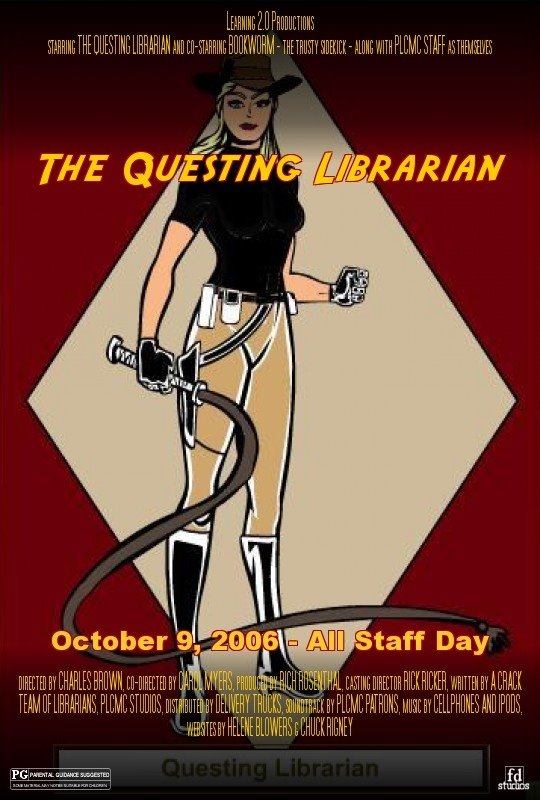
With Thing #10 Image Generators I got to bring my Librarian Action Hero to life with movie poster! I can see that others enjoyed them too based on the latest entry in Learning 2.0 - The L2 Image Slideshow. I know that many enjoyed Thing # 20 You Tube, Thing #21 Podcasting and Thing #22 Netlibrary but there wasn't as much making them "your own expression" as with the others mentioned.
Now I'd like to take that "avatar happiness" and hopefully apply it to the next generation of Library 2.0 and 3D Online Reference. A personal creative outlet meets service where the patrons are! And with my sharable customized start pages that I discovered as part of Thing #19 Web 2.0 tools I can keep track of all of these cool Learning 2.0 "things" in one place. Keeping track of these tools easily is the key to using them for resources and projects.
One thing that I would like to mention is that in order to complete each of the "23 Things" I found myself exploring while I was at work but posting my blog entries while I was at home so I wouldn't be distracted. For those staff that do not have computers at home, finding time to complete each of the entries was very much a challenge. I was especially concerned for the circulation staff because the majority of the circulation workstations to not have access to the open Internet, only sites on the PLCMC "yes" list through the proxy server.
If we did the project all over I would recommend that we:
1-Allow more time to complete the "23 Things". Some staff I spoke with lost their motivation to complete the project when they fell behind.
2-Put all the websites we are going to explore on the proxy server "yes" list so that circulation staff can access them from their workstations or have open Internet available on those workstations for the duration of the program.
3-Consider offering workshops for the "23 things". Even though some staff thrive on self-paced learning, others prefer workshops where they feel comfortable asking an instructor questions. Some staff felt uncomfortable asking others for help because they didn't want to prevent the helpers from completing their "things" too. Having a classroom setting lets a staff member step away from the day-to-day tasks and be able to focus on learning in an undistracted environment.
At my branch I felt these elements were there but I also want to say that everyone was very encouraging to each other. Anytime someone had a question there were mentors who were there to help. We all shared our successes and urged each other to continue so they could receive their MP3 player too!
If there was ever an incentive program like this in the future I know that I would probably participate. I'm sure the motivation from Learning 2.0 will inspire many other projects for some time to come. Now that we know about so many collabration tools it will hopefully make our jobs easier by not having to recreate the wheel everytime for resources and programming ideas but learn from others who shared through these Web 2.0 Tools.
Now I can go and read and comment on what other participants are saying and do a little sprucing up on my own little blog. :)
Wednesday, October 04, 2006
#22 Netlibrary : Downloadable eBooks
In exploring Netlibrary.com I actually found several audiobook titles that I was interested in. I have created my account and added many books to my favorites list. I'll be ready to download them on my MP3 player! This will give me a chance to listen to adult and children's classics and other authors such as Marion Zimmer Bradley, Brian Jacques and Elizabeth Peters that I may not have otherwise read due to time constraints. Our patrons will really enjoy having access to the audiobook collection of ESL and Foreign Language materials and the full text of the Holy Bible. I'll be sure to refer them to Netlibrary.  I deceided to download The Curse of the Pharaohs by Elizabeth Peters from Netlibrary. I chose "Download CD Quality" so that I could transfer it to the MP3 player. It said that it would download in 14 minutes over a cable modem. My file downloaded in about 6 minutes over a DSL modem. This was a 163 MB file with 6 Hours 39 Minutes of playing time. I opened it in Windows MediaPlayer and I was able play the audiobook. One thing I noticed right away is that there is no breakdown by chapter for easy reference. It is just one long audio stream. I had to remember to pause MediaPlayer and not stop it or I'd lose what time the story stopped on. I also tested it by closing out of MediaPlayer and opening it back up and sure enough it went back to the beginning. It does not remember where you stopped.
 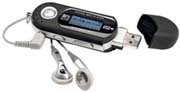 I hope that the MP3 player will have a way to pause the story even if it's turned off and then resume when it's turned back on again. Also, how is the MP3 player's battery charged and for how long? Would it be advisable to get a charger or is it automatically charged by putting it in a USB port? I hope to find out when I receive it.
Tuesday, October 03, 2006
#21 Podcasting - Directories and Creation Tools
Gabcast! Libraries & Technology #1 - Podcasting - Directories and Creation Tools
A verbal reproduction of my blog post about Learning 2.0 "thing" #21 - Podcasting.
Using Podcast.net I came across Talking with Talis and Amazon Wire.
Talking with Talis is hosted by Paul Miller from the UK. The focus is Library 2.0--where the movers and shakers of Web 2.0 and libraries come together to share their thoughts. Amazon Wire is the free podcast from Amazon.com which has interviews with the creators of books, music, and film.
Using the Podcastalley.com directory I found LibVibe. This is podcasts of the latest library headline news. At Yahoo! Podcasts I discovered NPR Books. This lead me to explore all the podcasting options available from NPR. There are a lot to choose from!
I was going to try to post a podcast of my own using Audioblogger.com but it is going away as of Nov. 1, 2006. They did offer other alternatives one of which is Gabcast.com. It does everything that Audioblogger does plus it has a 1-800 number too. It even has a feature where you can conference call a podcast. Great for interviews! So I went and set up an account. The instructions were straightforward and now you can hear this blog post as well as read it.
Monday, October 02, 2006
#20 YouTube : Video - The Mummy - In the Library
OK, I couldn't help myself. In keeping with the theme of the "librarian action hero" I chose The Library scene from the movie The Mummy (1999) featuring Rachel Weisz as librarian Evelyn Carnahan to add to my blog. Sometimes I feel that all librarians have had days like this! I almost chose Conan The Librarian as a post instead but it didn't have quite the "action hero" mold I was looking for.
It was really interesting to see what others had posted with the tags: library and librarian in YouTube. I really enjoyed the creative use that the folks at ImaginOn did with the clip, Troy Story. But also it seemed that searching for something specific was more difficult. Just typing in "library" brought up videos from inside actual libraries but also had quite a few spoofs like the Silent Library from Japan.
After looking at the site I thought it would be handy to have a library video search feature for the PLCMC family of websites. It would make a nice reference and PR tool. "Find Stars in Your Library!"
Wednesday, September 27, 2006
#19 Web 2.0 Tools - Start pages : "Pimped Out" Personalized Home Pages
It was very hard to just pick out "one" Web 2.0 Tool to talk about. I know that I didn't want to choose a tool similar to what we have already covered in the Learning 2.0 project so after looking at many types of resources I deceided that it would be best to look at start pages because it would be nice to have in one place all of these neat "things" we have been talking about. That way I can keep track of many more things that I could put in the sidebar of my blog. You could even create a separate library start page to help with reference questions or programming ideas if you wanted.
The three start page winners mentioned in the SEOmoz's Web 2.0 Awards grabbed my attention. I have been curious to know about what My Yahoo! alternatives were available. I was hard pressed to decide between the first two: Pageflakes.com and Google's Personalized Start Page.
Since I already have a Google account because of Blogger Beta I knew I had to try it out. Google's Content Directory is nicely separated out into category tabs for easy selection. It also lets you add your own modules or feeds. Nice. Although not as snazzy looking as Pageflakes, its ease of use was hard to beat.
Pageflakes has an AJAX start page which is more readable and easier on the eyes. It also has lots of feeds and "flakes" to populate your personal page with. It also organizes its content into categories but via drop down menus.
In both you could add your modules (pageflakes calls modules "flakes") or feeds and drag and drop them how ever you would like in you homepage layout. This is definately something that My Yahoo does not have. You can quicly add your own feed in both Pageflakes and the Google Start Page but Pageflakes doesn't have a way to let you add your own module yet. Google Start Page will let you add one via URL.
I probably use the Google Start Page for work related things and Pageflakes for personal stuff so that I can continue to monitor both for progress. I'm sure that at some point Pageflakes will let you add your own modules too. Overall start pages make a nice one stop shop for all of your personalized content.
#18 Web Based Apps - Writely
I discovered that Writely is also not supporting Blogger Beta yet so again I had to view my document as HTML, copy and paste the code into a post and do some clean up just like in Zoho Writer. Both are about the same in ease of use. The HTML tab in Writely is handy and only shows the code for the document. I did have to import the image directly into my blog post though and place it in the table in the blog. With Zoho Writer I didn't have to do that. So both have their pros and cons. I'll just be waiting for Blogger Beta support for either one so I can export directly.
 | Title: Egyptology : search for the tomb of Osiris : being the journal of Miss Emily Sands, November 1926-. Author: Emily Sands; Ian P Andrew; Nick Harris; Helen Ward; Dugald Steer Illustrator: Emily Sands; Nick Harris; Ian P Andrew; Helen Ward Publisher: Candlewick Press Pub Date: 2004 ISBN: 0763626384 Have you ever wanted to be an archaeologist like Indiana Jones? Then you would enjoy exploring the wonders of Ancient Egypt along with Emily Sands, explorer extraordinaire. Follow along in her journal scrapbook as she searches for the lost tomb of Osiris. The illustrations are very captivating. Every page will inspire you to explore the special features. These include postcards, envelopes, papyrus scrolls, foldouts, maps, treasure samples, minibooks, popups, and even playing pieces for a game of Egyptian Senet which is similar to checkers. Bring your magnifying glass because some of the text is hard to read. Will Miss Sands discover the mysterious tomb? Read and find out! If you would like other suggestions for reading take a look at Readers Club for adults and teens or Bookhive for young readers (or the young at heart!). |
Tuesday, September 26, 2006
#18 Web Based Apps - Zoho Writer
I thought I would take the book review that I did for the previous "thing" with wikis and see if I could create it with Zoho Writer and then save as .html code the way I wanted it.
 | Title: Egyptology : search for the tomb of Osiris : being the journal of Miss Emily Sands, November 1926-. Author: Emily Sands; Ian P Andrew; Nick Harris; Helen Ward; Dugald Steer Illustrator: Emily Sands; Nick Harris; Ian P Andrew; Helen Ward Publisher: Candlewick Press Pub Date: 2004 ISBN: 0763626384 Have you ever wanted to be an archaeologist like Indiana Jones? Then you would enjoy exploring the wonders of Ancient Egypt along with Emily Sands, explorer extraordinaire. Follow along in her journal scrapbook as she searches for the lost tomb of Osiris. The illustrations are very captivating. Every page will inspire you to explore the special features. These include postcards, envelopes, papyrus scrolls, foldouts, maps, treasure samples, minibooks, popups, and even playing pieces for a game of Egyptian Senet which is similar to checkers. Bring your magnifying glass because some of the text is hard to read. Will Miss Sands discover the mysterious tomb? Read and find out! If you would like other suggestions for reading take a look at Readers Club for adults and teens or Bookhive for young readers (or young at heart!). |
Once I figured out that I had to right click on the table to adjust
it the way I wanted things went a lot more smoothly. Having a
full feature text editor is really handy. This has so many more
features than the typical blog editor. It uses many of the standard
keyboard shortcuts already known to MS Office users. I did notice
however, that like many web based products that there is a delay
with saving if the Internet is very busy. The automatic save
feature helps in this matter. But otherwise it has many features
that I have come appreciate in a regular word processor. I wish it
had more help features and FAQs. That would have helped in my
struggle with understanding how to use the table feature.
Unfortunately Zoho writer does not support Blogger Beta so I can't publish directly to my blog.

I had to export the document and then copy and paste the source code into a blog post. Then I had to take out a lot of page breaks to get it to look somewhat decent. Oh well. I'm going to try Writely and see if I get better results.
Thursday, September 21, 2006
#17 PBWiki - Group Edited Webpage Creation Tool
I've added the Questing Librarian to the wiki plcmclearning : Favorite Blogs section. I also added a couple of Favorite Restaurants to the wiki as well. Then I experimented with adding a new page linked to the Favorite Books section. It is a book review on Egyptology from the popular "Ologies" series which include Dragonology, Wizardology, and Pirateology. Fairyopolis is similar to the "Ologies" series but is by a different publisher. I have also sent Egyptology and Fairyopolis to the children's book review site Bookhive for addition.
I just did some simple formatting for the book review entry in PBWiki because I'd have to look up how to put the text next to the book cover instead of underneath. It's a handy tool for easy editing of web pages. However, I'd have to consider all the factors of a software tool before I deceided to use it for what ever project I had in mind.
Wednesday, September 20, 2006
Blogger & Blogger Beta Comments
According to Blogger Buzz--Blogger beta and regular Blogger users are able to comment on each others blogs again. Hurray!
Tuesday, September 19, 2006
#16 Wikis - Group Edited Resources
I could easily see creating wikis for subject guides on topics similar to SJCPL's Subject Guides that we get asked about all the time. Especially for popular topics such as: local information, careers and jobs, geneology and local history, and senior exit projects. The IS File pathfinders on the Staff Intranet would be an excellent candidate for conversion. Also, I'm sure that every branch has staff finding lists for reader's advisory and homework support that would translate well to a wiki. The thing for any group wanting to create a wiki is to deceide--are we all going to create our own wiki on our topic and then link them in another wiki that links back to all of ours OR will there be one centralized library wiki and everyone goes in and adds posts on their topic? And how will we facilitate customer feedback? Will it be something that only librarians will contribute to or will patrons be able to contribute too? Also consider the costs of conversion, especially staff time required to do it.
The Book Lover's wiki looks like something the library already does with the Reader's Club website but with the ability of readers to add comments to a book that has been reviewed.
Library Success : a best practices wiki is a great idea. But like any group project it's only as good as it's contributions. Some areas don't have any entries yet.
The ALA 2006 New Orleans wiki was very easy to follow and understand. Everyone who is a conference participant would want to read the wiki to find out more information and topics of interest. They could also post what discoveries they had to share with others. I could see turning large library events into wikis such as the Novello Festival of Reading.
The Bull Run Library Wiki seemed like an example of a work in progress. It had features that were a cross between a blog and a wiki.
Other wiki examples that I found useful were:
1. The UCONN Library Staff Wiki. After looking at this site I immediately thought of our staff Intranet. If it was a wiki then all staff could post updates directly without having to go though a webmaster.
2. Biz Wiki from Ohio University. This is similar to our Bizling.org website. If conversion was an option, the same things that applied to the subject guides listed above would be factors here. Something else to consider--would it be better to just create a wiki separately as an adjunct to the website? Is there any other information that would be worthwhile adding that isn't already provided by the website?
3. The USC Aiken Gregg-Graniteville Library Wiki is sharp. Everything is so easy to find. I especially how they made finding articles in their online databases intuitive. It's not a cluttered site but everything seems within easy reach. What is difficult for any library homepage is to facilitate the fewest mouse clicks possible but still have the page not appear "busy". Also consider how much accessibility are you willing to give with the site--only have library staff add updates or have it open for all patrons? How will patron comments be presented? Will there be an assigned moderator of comments or will this be allowed to be moderated collectively?
4. The FLICC/Fedlink Environmental Scan Project blew me away with it's information. It's findings should make libraries take notice. A must read for anyone in libraries. Content and accessiblilty to all parts of the project were easy to follow with the outline in the sidebar and in the body of the page.
Thursday, September 14, 2006
#15 Library 2.0 - More Than Teen Gaming Night
There are several Web 2.0 technologies that I can see libraries incorporating with a little help from their vendors. If vendors deceide to not offer them they should at least make their products to where the library itself can add these features. For the library catalog these technology features include: built-in RSS feeds for keyword searches and popular groupings such as new feature films, user tagging with outdisrupting the original subject headers on the collection, and the ability for user commenting and ratings on books and articles. Comments and tags one patron adds will help the next one looking for the same topic. Library vendors could also adopt the features of Amazon.com and Google of interest to patrons. You could have personalized catalog logins where patrons can add these features to their "My Library Catalog". Give them a place to list their favorite titles, authors and genres and be able to share it with others. Library users should be able to use these resources inside or outside the library.
A great example is the Endeca-based NC State catalog. I got a chance to hear about it from from a presentation by Andrew Pace, Head of Systems at NCSU at the Spring 2006 ANCHASL Meeting.They took their old Dynix catalog and dumped it into Endeca. Endeca offers the ability to choose from numerous ways to navigate. It offers reference linking and next generation multisearch. You can limit by document type or browse the the entire collection by call number. It has an automatic citation builder that is available in various styles. It even has automatic spell check similar to Google's "did you mean this" feature. Librarians can create a Q&A on the fly and add to the library FAQ.
If the library offers in-house resources such as websites then these could also have RSS feeds, user access points for the submission of reviews, assignment of keywords (“tagging”), addition of scholarly commentary, and other forms of user participation. A good example of this is the Reader's Club website.
Also the library will want to plan content for the new communication services that are available today. These include: graphics tablets, Ipods & MP3 players, smart phones, PDA's, E-book readers, smart watches, and Blackberries. Patrons will get excited if you have content for their new gadget. Incorporating Web 2.0 technologies in the library will help provide content for these devices. Examples of how libraries are using Web 2.0 tools that I've read about include:
-a public information blog for library news, events & discussion of community needs
-a story-time Podcast for younger patrons
-using Flickr to photoshare library events
-creating a Wiki-style town history where residents can browse a list of historic homes and adding their memories to the public record with a simple Web form
-wikis for genealogists
-wikis for local information
-wikis to pool library information and standards
-blogs for internal library communication--library managers blog, reference blog, branch blog, circulation blog, library teams blog, IT communications with library staff blog, etc.
-An internal library PC and server inventory wiki.
-Voice and Video over IP for digital meetings when travel is difficult
-pushing content via RSS
-content creation resouces for patrons to record podcasts and develop digital videos
-interlibrary loan (ILL) purchase-on-demand from online used-book retailers
-open source wiki software to create a successful subject guide that facilitates customer feedback
-personalization of library web pages
-allowing customers to call impromptu book talks or discussion groups
-offering collaborative online MS Office alternative resources such as Writely and Writeboard, 37 Signals products - Basecamp, Backpack, and Ta-da Lists and Microsoft Office Live
-instant messaging reference services
-downloadable music, video, and audiobook services
-an iPod Shuffle loan program
-podcast of a teen band competition at the library
-podcasts for library classes and grand tours of the library
If we use Web 2.0 technology between library staff first and get comfortable with it then we can use it with our patrons and market the library.
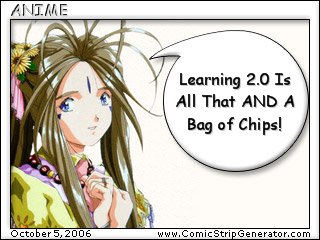
You might say, "Wow, Library 2.0 is is all that and a bag of chips but what about the future?"
I really enjoyed Dr. Wendy Schultz's article To a temporary place in time... the best out of the 5 perspectives in the OCLC Next Space Newsletter article Web 2.0 : Where will the next generation Web take libraries?. I think about what the the Joker said in Batman.."Think about the future, the future, the future..." It will transform and change us but also give us our special place where we can be in that fantasy zen zone for the mind--that place of wonder and exploration as a child--that we are all desperately trying to get back to when the world turned serious and growing up meant putting toys aside. I kind of equate it with moving from childrens resources with pictures and whizbang features like popups gizmos and textures to adult resources with boring text only. Yes it looks serious and authoritative. But who wants to read that? I'd much rather take the Japanese manga approch and have textbooks and manuals in picture format. They claim that learning is so much better. You absorb much more and the information is interesting. And that is really what we want. Information retrieval that is easy, pleasing to the eye, and facinating but with authority and expertise and a librarian guide to lead us to what we want with options--but not too many or we get information overload.
This librarian guide can be seen in person or online in 3D as an avatar in a virtual representation of the library. Each librarian has their subject specialties. When in a branch there is always one librarian that is the "go to" source for a particular topic be it scrapbooking or starting a business or travel tips. Patrons will collect trading cards on their favorite librarians and pass them on to other users. (Psst-Dude..check out this librarian...she pwns. Check her out if you need info on anything!)
But don't stop there! Create the library environment you have always wanted and integrate it with the virtual world. The virtual reality game Second Life has been host to many dual events online and live on location. Check out Jonathan Fildes article : BBC starts to rock online world. I can see the same thing happening in libraries. Library programming can be sent to the online game and show up on a video monitor for all avatars ingame to see. This would also be vice versa. If an event is going on in Second Life, all inside the library could see what is going on. Like satellite broadcasts of an event that has sold out in a stadium. Now those on the outside can see the show after all. No need to fight scalpers for tickets! Hmm..how about the Novello festival in Second Life?
And finally, make the library where you want to be in real life. Take a look at the OCLC Newsletter article Staying in the game! : How to create environments for Boomers and Gamers in your library especially the section Zone in on your users. People play virtual reality games to be in that fantasy zone where they want to live, create, and express themselves. Make it so in the library too. I want a library that partners with private vendors to offer a Starbucks Coffee/ Tea House type environment that everyone wants to be in. I want a community space thats buzzing with programming hipness and sound proof areas for quiet study to reach that "zen" state of lifelong learning. I want good natural lighting, plenty of windows, and comforable chairs. Take that zen feeling and make an enclosed Japanese style tea garden or an outdoor cafe. Have access to porches that open onto an arboretum with picnic benches and electrical outlets on the outside. I want all of that plus an information hub that is second to none. If I want to learn how to paint I can find it--online or with a guidebook and have access to digital tools to create on the spot. If I want to understand how DNA makes the world go round I should be able to find it at home, at work, or wherever I am. If the library doesn't have a book I want, I would like to walk over to a bookmaker machine, type in the ISBN and the machine prints it in 15 minutes--cataloged and ready to check out. Libraries can become the new star attraction that will put a city on the map. Make it something that every visitor will put on their "must see and do" list. Golden Gate Bridge, check, Broadway musical, check, Seattle Public Library, check, Salt Lake City Public Library, check...
So when are we going to have video games for checkout like Blockbuster? Patience young Padawan.
Wednesday, September 13, 2006
#14 Technorati : Tagging = Blog Marketing & Better Search Results
I searched Technorati using the keyword "Learning 2.0" and got very different results when I used the limiters of posts, tags, and Blog Directory. Also if you put the phrase in quotes you seem to get more accurate results.
I got 27,452 results from Learning 2.0 (no quotes) in blog posts.
I got 1,282 results using "Learning 2.0" in blog posts.
I got 51 posts tagged Learning 2.0 (no quotes) in tags.
I got 59 posts tagged "Learning 2.0" in tags.
I got 10 blogs about Learning 2.0 (no quotes) sorted by authority in blog directory.
I got 10 blogs about "Learning 2.0" sorted by authority in blog directory.
I'm assuming that "authority" means that someone tagged their blog with Learning 2.0. The tags list seemed to bring up the most matches for the Learning 2.0 project. I enjoyed the Advanced Search screen because it described what was being searched much better.
It was no surprise to me that the most popular blogs were on the topics of technology and news and top videos were hosted on YouTube. I was surprised to see Gregory Maguire's Wicked: The Life and Times of the Wicked Witch of the West and Carol Rose's Giants, Monsters, and Dragons: An Encyclopedia of Folklore, Legend, and Myth in the Popular Books listing. I know that Wicked inspired a Broadway musical. It's nice to see that fantasy and folklore are so popular.
I don't have to worry about adding HTML code to my blog posts because since Blogger Beta incorporates labels (called categories in other blogging software) and publishes to a RSS/Atom feed Technorati will automatically read them as my tags for my blog in Technorati. Sweet! So I went back and added labels to all of my posts and created a section in my sidebar for my label categories. All of my blog posts have the label PLCMCL2. I have both "Learning 2.0" and "PLCMCL2" in my watchlist. I "claimed" my blog in an earlier post on RSS Feed Search Tools.
Technorati Tag: PLCMCL2

Flickr Support for Blogger Beta
Hurray Flickr now supports Blogger Beta! Check out the article Flickr Support for Blogger in Beta in the Blogger Buzz blog. Now I can post pictures directly from Flickr to my blog!
Now if I could just get the Rollyo Searchbox to work. Hmmm. I guess I'll just have to wait for those improvements. Sigh.